


 +86 18130251359
 teflowpumps@tlpumps.com

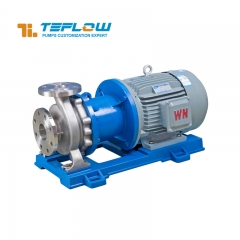




The low temperatures of winter pose a severe challenge to the stable operation of chemical pumps: the expansion of the medium when it freezes can easily lead to pump body cracking, impeller jamming, and embrittlement of seals, which can cause leakage risks. In some cases, equipment failure may even cause production interruption or safety accidents. We will systematically review the core knowledge and practical measures for winter antifreeze of chemical pumps to ensure the safe overwintering of equipment.
The freezing and blockage problem of chemical pumps is essentially the result of the combined effects of changes in the state of the medium under low-temperature conditions and the structural characteristics of the equipment. First, if the medium being transported contains moisture (such as some solvents or reactants), or if water remains in the pump body or pipeline after the pump is stopped, the moisture will freeze and expand in volume when the temperature drops below 0°C, generating enormous physical stress that directly squeezes the pump body, impeller, and other precision components, leading to cracks or deformation. Second, some high-viscosity media experience a significant increase in viscosity at low temperatures, resulting in a sharp increase in flow resistance. This not only reduces the pump's delivery efficiency but may also form a "stagnant layer" inside the pump cavity, further exacerbating the risk of localized freezing and blockage. Furthermore, in areas with small clearances, such as the sealing cavity and shaft sleeve of the chemical pump, if residual medium freezes, it can easily cause component jamming, leading to seal failure or motor overload.
The antifreeze work of chemical pumps should follow the principle of "prevention first and comprehensive management", and a targeted plan should be formulated based on the equipment operating status, medium characteristics and environmental conditions.
1.Equipment Pre-treatment: A Basic Course on Freeze Protection Before Pump Shutdown
For chemical pumps that need to be shut down or put on standby, thorough pretreatment is the first line of defense against freezing and blockage. First, the "purging" work must be done well - after stopping the pump, close the inlet and outlet valves, open the drain valve and empty valve at the bottom of the pump body, and completely drain the medium inside the pump chamber. Pay special attention to dead corners where water can easily accumulate, such as the impeller and sealing cavity. If necessary, compressed air can be connected through the inlet flange to purge and ensure that there is no residue. If the medium being transported is prone to crystallization or has high viscosity, the pump chamber should be flushed with clean water or a special solvent after emptying to prevent residual media from hardening and clogging at low temperatures.
Secondly, the standby pump needs to be insulated. For pumps that are kept in standby for a long time, they can be wrapped with removable insulation cotton or insulation sleeves, focusing on covering the pump casing, sealing cap, inlet and outlet short pipes, etc. The thickness of the insulation layer needs to be determined according to the local minimum temperature. It is generally recommended to use flame-retardant insulation materials with a thickness of more than 50mm in areas below -10℃。 At the same time, it is necessary to check whether the insulation layer is intact. If there is any damage or crack, it should be repaired in time to prevent cold air from seeping in and forming a "cold bridge".
2.Operational Management: Keeping the Pump Moving to Prevent Freezing
For chemical pumps that operate continuously in winter, maintaining media flow is key to preventing freezing and blockage. First, ensure "minimum flow circulation"-when the actual pump output is less than 30% of the rated flow, the minimum flow return line should be opened to allow some of the medium to return to the storage tank or inlet end, ensuring continuous flow of the medium inside the pump chamber and avoiding local stagnation and freezing. It is important to ensure the return line valve opening is appropriate, meeting anti-freezing requirements while avoiding excessive return that leads to energy waste.
Secondly, it is necessary to monitor the "medium temperature and viscosity". If the medium being transported is temperature sensitive, a heat tracing device can be installed on the pump inlet pipeline. The two most common methods are steam heat tracing and electric heat tracing. Steam heat tracing is suitable for scenarios with a steam source. The heat tracing pipeline needs to be tightly attached to the pump inlet pipeline and wrapped with an insulation layer. Care should be taken to control the steam pressure to prevent local overheating. Electric heat tracing is suitable for scenarios without a steam source or for small pumps. Explosion-proof electric heat tracing tape should be selected, evenly wrapped around the surface of the pipeline, and then covered with an insulation layer. At the same time, a temperature controller should be equipped to stably control the medium temperature at 5-10°C above the freezing point.
In addition, regular "switching operation" is also important. For multiple chemical pumps operating in parallel, a rotation operation plan needs to be developed. Generally, the standby pump should be switched every 2-3 days. After starting, it should run for 10-15 minutes to ensure the flow of the medium inside the pump chamber. At the same time, the operating status of the equipment should be checked to avoid the standby pump freezing or getting stuck due to long-term idleness.
3.Emergency Treatment: How to Safely Handle Freezing Blockage
If a chemical pump is found to be frozen and blocked, do not force the motor to start, otherwise it may cause the motor to burn out, the pump body to crack, or the impeller to be damaged. The correct handling steps are as follows: First, close the pump's inlet and outlet valves, disconnect the power supply, and check the frozen area, which usually occurs in the pump chamber, inlet and outlet pipes, or drain valve; Second, choose the thawing method according to the degree of freezing. For minor freezing, you can slowly pour warm water (40-60℃) into the frozen area, or use a hot steam hose to heat it. It is strictly forbidden to use an open flame to directly heat the pump body to avoid uneven heating and cracking of the pump body; After thawing, open the drain valve to drain the accumulated water, check whether the pump body seals, impeller and other components are intact, and start the pump only after confirming that everything is in order.
Winter freeze protection for chemical pumps is a systematic project. Establishing a sound winter freeze protection inspection system, regularly checking the insulation layer, heating device, and pump body operating status, and promptly identifying and addressing potential hazards are essential to ensure the stable operation of chemical pumps in low-temperature winter environments, providing strong support for the safe and efficient production of chemicals.



 +86+0563-5093318
