


 +86 18130251359
 teflowpumps@tlpumps.com

As a major industrial water consumer, the printing and dyeing industry produces 100–200 tons of wastewater for every ton of textiles dyed and printed. This wastewater accounts for about 80% of China’s total industrial wastewater discharge, making it one of the typical types of industrial wastewater that are difficult to treat.
Printing and dyeing wastewater has a complex composition: it contains not only organic pollutants such as dyes, pastes, and additives, but also solid particles including fiber debris and dye residues. Its pH value mostly ranges from 2 to 12, featuring both strong corrosiveness and high abrasiveness. For transporting such challenging wastewater, the key is to select the right pump type — a proper choice reduces downtime and maintenance costs, while an unsuitable pump can cause corrosion, clogging, and even disrupt the normal operation of the entire printing and dyeing production line.
I. Characteristics of Printing and Dyeing Wastewater Determine Core Pump Requirements
To choose the right pump, we must first understand the properties of printing and dyeing wastewater. Its three core characteristics directly define the pump selection criteria:
1.Strong Corrosiveness
Wastewater contains dyes, acidic and alkaline additives, with large pH fluctuations. The pH of some mercerizing wastewater can even reach 12–13, which easily corrodes ordinary metal pump bodies and causes leakage or damage.
Therefore, the wetted parts of the pump must have excellent acid and alkali corrosion resistance.
2.High Solid Content & Easy to Wear
Wastewater contains a large amount of fiber debris and dye residues; some particles have a hardness up to HV500, with 3–5 times the scouring force on the impeller and pump body compared with ordinary media.
This requires the pump to have good wear resistance to withstand long-term erosion by solid particles.
3.Variable Water Quality & Prone to Clogging
Wastewater from different processes (desizing, scouring, dyeing, printing) varies greatly in composition and concentration. Some contains high-viscosity pastes, while others have fine fibers that easily wrap around and block the flow channel.
Thus, the pump structure must adapt to complex water quality to minimize clogging risks.
II. Mainstream Pump Selection: Pros, Cons and Applicable Scenarios
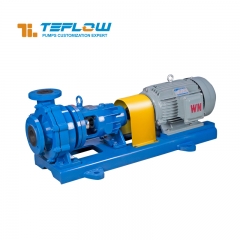
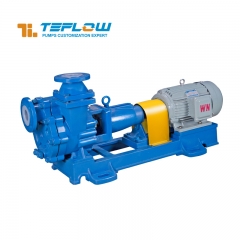
1. Slurry Pump
The Main Choice for Highly Abrasive and High-Solid Wastewater
The slurry pump is core equipment for treating highly abrasive wastewater in the printing and dyeing industry, especially suitable for transporting wastewater rich in dye residues and fiber particles (e.g., from dyeing and printing processes).
Its core advantages: wear resistance and anti-clogging performance. It can handle wastewater with a solid concentration of 20%–50% and particle size of 2–10 mm.
Applicable scenarios: Dyeing wastewater, printing wastewater, wastewater with high-concentration fiber sludge.
Inapplicable scenarios: Low-solid, strongly corrosive acidic/alkaline wastewater (easily corrodes metal components).
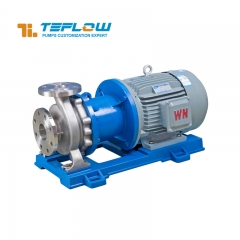
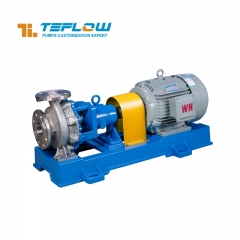
2. Magnetic Drive Pump
A Leak‑Free, Safe Choice for Strongly Corrosive Wastewater
For printing and dyeing wastewater with large pH fluctuations and toxic/hazardous components (e.g., wastewater containing heavy metals or cyanide), the magnetic drive pump is a more appropriate option.
Its core advantage: zero leakage, fundamentally eliminating environmental pollution and equipment damage caused by wastewater leakage, while providing good corrosion resistance.
Wetted parts can be made of corrosion-resistant materials such as fluoroplastic (F46) and 316L stainless steel, adapting to different pH levels. The operating temperature ranges from -20°C to 120°C, suitable for various working conditions in dyeing and printing plants.
It also has low maintenance costs, no shaft seal wearing parts, and simple troubleshooting — ideal for small and medium-sized printing and dyeing enterprises with high environmental requirements and strongly corrosive wastewater.
Applicable scenarios: Strongly acidic/alkaline wastewater such as desizing wastewater and mercerizing wastewater, as well as toxic and hazardous printing and dyeing wastewater.
Inapplicable scenarios: High-solid, large-particle wastewater (easily wears the impeller and causes clogging).
3. Screw Pump
Expert for High‑Viscosity, Easy‑to‑Wrap Wastewater
The screw pump adopts a progressive cavity structure and belongs to positive displacement pumps. Its biggest advantage is the ability to transport high-viscosity, easy-to-wrap media without clogging caused by fibers or pastes, making it suitable for desizing wastewater and sludge with a large amount of fibers in printing and dyeing plants.
It provides stable flow, adapts to highly concentrated viscous wastewater, runs smoothly with low noise, and is suitable for scenarios requiring high delivery stability.
Applicable scenarios: Desizing wastewater, fiber-rich sludge, high-viscosity printing and dyeing pastes.
Inapplicable scenarios: Highly abrasive, large-particle wastewater (causes rapid wear of the stator and rotor).
III. Conclusion
Efficient transportation of printing and dyeing wastewater is the first step in the wastewater treatment process and the foundation for ensuring the smooth operation of the entire system.
Given its complex and variable water quality, selecting a transport pump with suitable materials, reasonable structure, and reliable operation is critical.
By thoroughly analyzing actual working conditions and comprehensively evaluating the technical features of different pump types, a more economical, efficient, and durable pumping solution can be matched for the wastewater treatment system, providing solid support for stable production and environmental compliance of enterprises.



 +86+0563-5093318
