


 +86 18130251359
 teflowpumps@tlpumps.com

In the production processes of petrochemical, coal chemical, pharmaceutical and other industries, the generation of benzene-containing wastewater is inevitable. As a national key controlled priority pollutant, benzene is a clear Class I carcinogen with three hazardous characteristics: high volatility, high toxicity, flammability and explosiveness. Even a trace leakage may endanger personnel health through respiration and skin contact. Volatilized gas can easily trigger explosions when exposed to open flames, and also cause serious soil and water pollution. Therefore, in the collection and transportation of benzene-containing wastewater, pump selection is not only related to process stability, but also directly concerns personnel safety and environmental compliance.
Different from conventional wastewater transportation, the particularity of benzene-containing wastewater imposes extremely stringent requirements on pump performance. Combined with industrial practice and safety specifications, the selection criteria for benzene-containing wastewater transfer pumps can be precisely summarized into three points: zero leakage as the bottom line, organic solvent resistance as the foundation, and explosion-proof design as a necessity. Only by meeting these three requirements simultaneously can the safe, efficient and compliant transportation of benzene-containing wastewater be realized. Below, we comprehensively elaborate the selection logic of benzene-containing wastewater transfer pumps from two dimensions: core selection criteria and applicable pump types, with a focus on the optimal pump option — magnetic drive pumps.
I. Core Selection Criteria: Three Indispensable Standards to Build a Solid Safety Barrier
The high-risk nature of benzene-containing wastewater determines that pump selection must focus on safety, leak tightness and corrosion resistance. The three core standards are interrelated and indispensable, forming a closed safety loop for benzene-containing wastewater transportation.
1. Zero Leakage: The Primary Bottom Line for Safety and Environmental Protection
Due to benzene’s high volatility and high toxicity, "zero leakage" is the top requirement for benzene-containing wastewater transfer pumps. Any minor leakage may lead to the diffusion of benzene vapor, triggering safety accidents such as personnel poisoning, fire and explosion. Meanwhile, it will violate environmental emission regulations and result in severe penalties. Traditional pumps with packing seals have large leakage and cannot meet the transportation demands of benzene-containing wastewater. Although ordinary mechanical seals can reduce leakage, they are prone to seepage risks due to wear and aging after long-term operation. Hence, pumps must adopt a shaft-seal-less and fully enclosed structure to eliminate leakage fundamentally.
2. Organic Solvent Resistance: Ensure Long-Term Stable Operation of the Pump
Benzene and its derivatives in benzene-containing wastewater (such as toluene and xylene) are strong organic solvents with high corrosiveness. They can severely erode ordinary metal materials like cast iron and carbon steel, damaging pump casings, impellers, seals and other components. This not only shortens the pump service life but may also cause leakage accidents due to component damage. Therefore, organic solvent resistance is the basic requirement for benzene-containing wastewater transfer pumps, which relies rationally on the selection of pump casing materials.
In accordance with medium characteristics, pump casings shall prioritize materials resistant to organic solvents and corrosion, commonly including stainless steel (304, 316L), fluoroplastics (FEP, PFA), silicon carbide, etc. Among them, 316L stainless steel is suitable for most benzene-containing wastewater scenarios, featuring both corrosion resistance and mechanical strength. Fluoroplastic materials are applied to working conditions with high benzene concentration and stronger corrosion, effectively resisting erosion from organic solvents. Silicon carbide is mainly used for wear-prone parts such as pump bearings; its high strength and wear resistance extend pump service life and enable stable operation even if the medium contains a small amount of impurities. In addition, pump seals shall adopt benzene-resistant fluororubber or PTFE materials to avoid leakage caused by seal aging and corrosion.
3. Explosion-Proof Design: Essential Safeguard Against Flammable and Explosive Risks
When mixed with air within a certain concentration range, benzene vapor forms an explosive mixture, which can easily detonate when exposed to open flames, high temperature or electrical sparks. During the transportation of benzene-containing wastewater, sparks may be generated by pump motor operation and component friction. Thus, explosion-proof design is a mandatory selection requirement, which must strictly comply with explosion-proof standards to eliminate all ignition sources.
Explosion-proof requirements are mainly reflected in two aspects: First, the motor shall be an explosion-proof type with common explosion-proof grades of Exd II BT4 or Exd II CT4 (selected according to benzene’s explosion hazard grade), ensuring no spark generation and excessive temperature rise during motor operation, and adapting to explosive hazardous environments for benzene-containing wastewater transportation. Second, the overall pump structure shall adopt explosion-proof design. For instance, magnetic drive pumps are equipped with a fully explosion-proof structure outside the motor to prevent sparks from metal friction, while reducing vibration and noise during pump operation to lower ignition risks. In addition, the electrical control part of the pump must also meet explosion-proof specifications to avoid safety accidents caused by electrical faults.
II. Applicable Pump Type: Magnetic Drive Pump — The Optimal Solution for Benzene-Containing Wastewater Transportation
Complying with the three core selection criteria of zero leakage, organic solvent resistance and explosion-proof design, magnetic drive pumps stand out with structural advantages, strong adaptability and convenient maintenance. They have become the preferred pump type for benzene-containing wastewater transportation, covering most working conditions while balancing safety, efficiency and compliance, and serving as the most widely used and reliable dedicated pump in the industry.
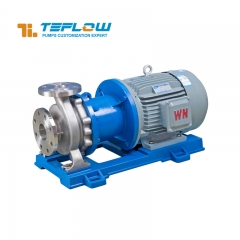
Magnetic drive pumps are leak-free pumps specially designed for flammable, explosive, highly toxic and corrosive media. They fully satisfy the three core requirements of zero leakage, organic solvent resistance and explosion-proof performance for benzene-containing wastewater. Applicable to most working conditions, they operate stably for both conventional low-concentration benzene-containing wastewater and moderately corrosive benzene-containing wastewater with trace impurities, making them the mainstream choice in the industry at present.
Apart from qualified core performance, magnetic drive pumps have remarkable practical advantages: simple structure, compact size and easy installation without complex pipeline supporting facilities; low maintenance cost with no regular seal replacement required, reducing downtime for maintenance; process fluid can cool and lubricate transmission components by self-circulation, eliminating the need for additional cooling or lubrication systems. They adapt to continuous production scenarios and greatly improve process stability.
For adaptation details under different working conditions, two key points should be noted: First, if benzene-containing wastewater contains a small amount of solid impurities, select magnetic drive pumps fitted with SSiC bearings. Their high strength and wear resistance prevent pump casing abrasion by impurities and prolong service life. Second, for working conditions involving benzene-containing wastewater at different temperatures, cooling or insulation jackets can be added to flexibly adapt to high or low-temperature transportation demands and further enhance pump adaptability.
III. Conclusion: Precise Adaptation as the Core of Selection, Prioritizing Safety and Compliance
The high-risk attribute of benzene-containing wastewater dictates that pump selection must adhere to the core principle: zero leakage as the bottom line, organic solvent resistance as the foundation, and explosion-proof design as a necessity. The three principles support each other and are indispensable. As a dedicated pump designed for high-risk media, magnetic drive pumps perfectly meet the three core requirements and fit most benzene-containing wastewater transportation conditions, making them the optimal choice for enterprises.
In addition, attention shall be paid to pump manufacturing standards during selection. Priority should be given to products that meet national safety and environmental standards and hold relevant qualifications. Meanwhile, proper pump installation, commissioning and daily maintenance are essential — regularly inspect the operating status of pump casings, seals and motors, and replace aging components in a timely manner to ensure long-term stable pump operation. Only in this way can process stability be guaranteed, the bottom line of personnel safety and environmental compliance be maintained, and the safe and efficient transportation of benzene-containing wastewater be realized.



 +86+0563-5093318
